Wednesday, August 20, 2014

Kilroy


This came in from Internet Trivia. Nobody but us chronologically gifted Americans know a damm thing about Kilroy.This is probably about as close to the truth as anything we'll ever know. -Ed


He is engraved in stone in the National War Memorial in

Washington,DC- back in a small alcove where very few people
have seen it. For the WWII generation, this will bring back memories.
For you younger folks, it's a bit of trivia that is a part of our American
history. Anyone born in 1913 to about 1950, is familiar with Kilroy.
No one knew why he was so well known-but everybody seemed to get into it.

So who was Kilroy?

In 1946 the American Transit Association, through its radio program,"Speak to America ," sponsored a nationwide contest to find the real Kilroy, offering a prize of a real trolley car to the person who could prove himself to be the genuine article. Almost 40 men stepped forward to make that claim, but only James Kilroy from Halifax, Massachusetts, had evidence of his identity.

Kilroy'was a 46-year old shipyard worker during the war who worked as a checker at the Fore River Shipyard in Quincy. His job was to go around and check on the number of rivets completed. Riveters were on piecework and got paid by the rivet. He would count a block of rivets and put a check mark in semi-waxed lumber chalk, so the rivets wouldn't be counted twice. When Kilroy went off duty, the riveters would erase the mark. Later on, an off-shift inspector would come through and count the rivets a second time, resulting in double pay for the riveters.

One day Kilroy's boss called him into his office. The foreman was upset about all the wages being paid to riveters, and asked him to investigate. It was then he realized what had been going on. The tight spaces he had to crawl in to check the rivets didn't lend themselves to lugging around a paint can and brush, so Kilroy decided to stick with the waxy chalk. He continued to put his check mark on each job he inspected, but added 'KILROY WAS HERE' inking-sized letters next to the check,; eventually added the sketch of the chap with the long nose peering over the fence; that became part of the Kilroy message.

Once he did that, the riveters stopped trying to wipe away his marks.Ordinarily the rivets and chalk marks would have been covered up with paint. With the war on, however, ships were leaving the Quincy Yard so fast that there wasn't time to paint them. As a result, Kilroy's inspection "trademark" was seen by thousands of servicemen who boarded the troopships the yard produced.

His message apparently rang a bell with the servicemen, because they picked it up and spread it all over Europe and the South Pacific.

Before war's end, "Kilroy" had been here, there, and
every where on the long hauls to Berlin and
 Tokyo. To the troops outbound in those ships, however, he was a complete mystery; all they knew for sure was that someone named Kilroy had "been there first."As a joke, U.S. servicemen began placing the graffiti wherever they landed, claiming it was already there when they arrived.

Kilroy became the U.S. super-GI who had always "already been"wherever GIs went. It became a challenge to place the logo in the most unlikely places imaginable (it is said to be atop Mt. Everest, the Statue of Liberty, the underside of the Arc de Triomphe, and even scrawled on the dust on the moon .

As the war went on, the legend grew. Underwater demolition teams
routinely sneaked ashore on Japanese-held islands in the Pacific to map the terrain for coming invasions by U.S. troops ( thus, presumably, were the first GI's there). On one occasion, however,they reported seeing enemy troops painting over the Kilroy logo!

In 1945, an outhouse was built for the exclusive use of Roosevelt, Stalin,and Churchill at the Potsdam conference. Its' first occupant was Stalin, who emerged and asked his aide,
"Who is Kilroy?"

To help prove his authenticity in 1946, James Kilroy brought along officials from the shipyard and some of the riveters. He won the trolley car, which he gave to his nine children as a Christmas gift and set it up as a playhouse in the Kilroy yard in Halifax,Massachusetts.


And The Tradition Continues...


EVEN Outside Osama Bin Laden's House!!!


-From the Internet. All I did was add the pictures.  -Ed

Monday, August 18, 2014

Now They Tell Me

As young whippersnappers just starting out in the workplace, much of our time was spent thinking about "getting ahead" and being a success.

Well now I learn that what we really should have been doing was.............DOODLING.

At least that's what Suni Brown, author of the "DOODLE REVOLUTION" thinks.

 In her now famous TED talk, she proposes that doodling is deep thinking in disguise and that it is a simple, accessible tool for problem-solving in general. In fact, Brown believes doodling spontaneous marks actually helps you think.

Long dismissed as a waste of time, doodling is getting new respect.
Recent research in neuroscience, psychology and design shows that doodling can help people stay focused, grasp new concepts and retain information. A blank page also can serve as an extended playing field for the brain, allowing people to revise and improve on creative thoughts and ideas.
Doodles are spontaneous marks that can take many forms, from abstract patterns or designs to images of objects, landscapes, people or faces. Some people doodle by retracing words or letters, but doodling doesn't include note-taking.
"It's a thinking tool," says Sunni Brown, an Austin, Texas, author of a new book, "The Doodle Revolution." It can affect how we process information and solve problems, she says.


Here Are the "DOODLES" President Kenedy drew during the Cuban Missile Crisis.
Another by JFK

Clinton
LBJ


Frankly, in my opinion both Ronald Reagan and Barack Obama had at least ONE thing in common. They both must have been aware that their doodles were being saved by historians so there were no longer Circles and squares and swiggly lines. Somewhere in the huge Washington bureaucracy  I bet there is at least one person whose only job is drawing Presidential Doodles.
When I find him, I'll give you his name.


Anyway, I personally tested Suni Browns theory of DOODLING as "Mental Floss" and sure enough...I tried it and immediately started thinking more clearly!
I suddenly realized that her doodle theory is a bunch of hogwash, and is about as effective as tying your shoes or taking out the garbage.
Only, with those 2 things, you at least accomplish something.

-Ed


Miss Me?

Sorry I've been away for a few weeks. I have been "down and out" with SHINGLES.

I hope to heck you never get that disease. Anyone who has ever had Chicken Pox is at risk.

Here is the internet defination:

After you have chickenpox, the virus that caused it, called varicella, remains in your body. It's always inside you, lying dormant (or asleep) in your nerve cells. At some point later in life, your immune system may weaken, allowing the virus to resurface as Shingles. You may be feeling great, but if you've had chickenpox, the Shingles virus is already inside you. And your risk for Shingles increases as you get older.

Well, I certainly qualitied.and I suspect most of you do too, although I hope you don't get it. Lordy, Lordy, it is awfully painful! It has kept me out of commission for almost a month, and it still hasn't gone away completely.  It's only slightly improved.


Try to catch it early!  It often mimics "a heart attack."  That's the way it started with me. I wasted time getting EKG's and stuff...so look  carefully for red spotches ...they can even appear on your face. The sooner you start treatment, the less severe it will be!


PASSING SCENE


I can't count the number of times over my lifetime that I said to myself,
"Oh, if only I had a camera with me to take a picture of that!"

Well, now, just about all of us have one (in our mobile phones) but, more often than not, I forget about it.


So, on my 3 by 5 cards that I write down every thing I want to remember, I have added a reminder to myself that I HAVE ONE...and can take snapshots of things that, I once could only say "I wish I had a picture of that."

Mostly little things....anything that I find interesting in my day to day existence.

For example:


and,
Now, why I find the PNC Bank poster amusing is, to me she looks a lot like Amelia Earhart.
And, you know how she wound up. Perhaps I missed the point they were trying to make, but  since i  consider myself "Mr. Average"  I figure, if it went "over my head," it probably was missed by others as well.


Amelia Earhart


Just think of the pictures we could have taken during our years at Central!

On second thought, I'm glad we didn't have them back then!


Feel free to send me any snapshots that you take during your exciting daily peregrination thrrough our "Golden Years."


-Ed

Email to:  shephard@gmail.com


Sunday, July 27, 2014

Out of the Past


Even though I've finally retired, I still "play" radio and TV.  I've left instructions that when they finally send me to "the Home," they are to include a cardboard mic and toy TV camera that I can amuse myself with while I wait for my final ride home.


Meanwhile, I'm still doing my OUT OF THE PAST show interviews on Virginia's Fairfax Cable Channel and posting them on the Internet at

 www.otpfiles.blogspot.com

 My focus lately has been  WW2 veterans. I want to get as many of these heroes' stories on Video as I can.
Just last week we had scheduled  a US fighter pilot named Bob Clark to appear on the show who had fought in the Battle of Britain during the summer and autumn of 1940.

Unfortunately, just a few days before the interview was scheduled, we learned that Bob had passed away.

Bob's participation in England's famous battle was very unusual because the US was
officially still "neutral" then and it was illegal for any American to participate in "Europe's War." The penalty for doing so was imprisonment and loss of citizenship.

In spite of that, at least 9 American pilots flew for the Brits. 9 was the "official" number, but there were many more, Bob Clark being one of them. Only 9 admitted their American citizenship and revealed their real names. The others, like Bob Clark listed false names and citizenship. 


One of the volunteers was 29 year old Billy Fiske, one of the most spectacular sportsmen in Olympic history.  He had completed the Le Mans 24 hour auto race when he was only 19 and earned the title "The King of Speed" by dominating bobsledding at the age of 16, the youngest ever winner  of a winter Olympics gold medal for the bobsled.

Fisk and, I believe, most of the other American pilots were killed in those dogfights. I understand that Hollywood either has or is thinking about a movie about Fiske. There is also an Aspin Colorado connection. Fiske was responsible for construction of the first ski lift at that location.

Technology moves so fast these days that it's almost impossible to keep up. In 1951 our  music was all on 78 rpm records. A few years later the 45's and 33 1/3 came along. Then 8 track, then the cassette...etc.

Now, I'm not sure what the most popular listening device is for music.  The Ipod?  Heck, I can't keep up, but I know the audio cassette has almost disappeared.  I received one last week that the person found in his parent's old cedar chest and had no idea what was on it or how to listen to it. But he suspected it might contain some valuable "family history."

It does, but the quality is poor.

It's of his father describing his adventures in WW1.  If it's as interesting as I think it will be, I'll pass along a few excerpts. It would not be unusual for a few in our class to have had fathers who fought in WW1.

I've only been able to "skim" the tape, but one thing that got my attention was the fact that he mentioned "Peach Pits" a number of times.  He said that Americans were collecting peach pits.  I immediately thought of our childhood and the collection of tin cans and "silver paper."


Well, it turns out that peach pits saved thousands of lives on the battlefield since it was learned that the dreaded poison gas the Germans were using could be subdued with activated charcoal, made from peach pits.

Nobody talks about WW1 anymore, but I believe most historians now agree that it shouldn't have happened.

They say it started almost by accident. So many nations had so many "treaties" that the one nut who shot the Archbishop Somebody of Somewhere more or less automatically triggered that horrible war.

The total number of military and civilian casualties in World War 1 was over 37 million.

The Battle of Verdun lasted 10 months, the French suffered 540,000 casualties and the Germans 430,000 and no strategic advantage was gained by either side.

After I've listened to the whole tape, I'll let you know what that voice from the past was thinking.

Stay tuned.

-Ed

Pile the bodies high at Austerlitz and Waterloo.
Shovel them under and let me work—
 I am the grass; I cover all. 

And pile them high at Gettysburg
And pile them high at Ypres and Verdun.
Shovel them under and let me work.
Two years, ten years, and passengers ask the conductor:
     What place is this?
    Where are we now?


     I am the grass.
     Let me work.
-Carl Sandburg

Monday, July 21, 2014

Maverick

I was saddened by James Garner's death last week, although anyone who lives a life as successful and long as he did left "on quite a rush;" which is a card shark's term meaning running extremely lucky and winning a large proportion of hands.

Bret Maverick, the adroitly articulate card shark on Maverick is the way I remember him.  That show premiered on TV in September of 1957 nine months before I went to work for my first commercial TV station, WSOC-TV.  As I recall, it was the most popular non CBS show to ever compete with the Tiffany network up to that time.

By the summer of 1958, it had really begun to get high ratings and those of us at Charlotte's channel 9 were ecstatic to know that we finally might beat WBTV, the big boy on the block, in at least ONE time slot.

We were well aware that we were number two in town, not only the second TV station to go on the air (Channel 3 had been broadcasting since 1949. It was the 13th TV station in the entire USA at the time.) we also were affiliated with the number two (and 3) NETWORKS, NBC and ABC. There is a truism in TV that if you owned a CBS Television station in the 1950's and 60's...it was impossible not to become rich.

The building that now houses WSOC-TV was in the process of being built in the summer of 1958, so we broadcast our shows from the small transmitter building located in the Newell-Hickory Grove neighborhood, just outside Charlotte's northeastern city limits. Our one studio was less than the size of the average living room. All of our live shows came out of there, including Jimmy Kilgo's Saturday dance parties. In addition, all of our electronic equipment was also stuffed into that small building

So we were struggling. However, our management was eagerly looking forward to the next rating book to come out showing how strong that the Maverick time period was.  That would mean a lot of money for the station. Plus, psychologically, it would have been a big boost for us. Almost everyone who worked at the station were pros with the possible exception of members of the "floor crew," and these were "trainees," many of whom worked their way into full time positions.
However, as in any business, there were some "clunkers."


It was just such a clunker who, on the first day of the rating period, accidentally spilled his soft drink into the main "switcher" and knocked the station off the air...for a week.
What a week to be off the air!

I'm not saying if that had not happened, Channel 9 would have overcome Channel 3's nine year "head start" and its CBS affiliation advantage but it sure would have felt good.

However, to quote Maverick himself,

''As my old pappy used to say,  Never cry over spilt milk. It could've been whiskey."

-Ed


*Actually, WSOC-TV was Charlotte's third television station, after WBTV (channel 3) and WAYS-TV (channel 36, which operated from 1954 to 1955); it was Charlotte's second station on the VHF band. 


Friday, July 18, 2014

Cussing

I was wrong when I said (a couple of posts ago) that the first thing I was taught as a young radio announcer was that "silence was deadly."

That was the second.

The first one was, DON"T CURSE on the air.


(Actually, Mr, Fitz, WGIV's owner, and the best boss I ever had in all the 63 years after that said "Don't CUSS on the air.)

Of course, the words he was talking about are considered mild, and even acceptable today.  "Damm" and "Hell" were the ones he had in mind. I think those were just about the only ones anyone knew back then.

It only required a little common sense to instinctively know not to spout obscenities over the airwaves intentionally, but he was warning us about accidentally letting something slip out.


There was a popular musical group called the Art Van Damm Quintet in the early 50's that we were required to announce as the Art Van Darn or the Art Van Dern Quintet.
Sometimes we called it the Art Van Heck Quintet.

The first person that I ever heard let a cuss slip out on WGIV was Eric Dehlin who ended the first half of his morning music show one minute before Julian Barber sat down to read the 12 noon news.  Now, WGIV only had one studio, one mic...and one chair for the on the air personality;  Julian, being the great prankster that he was would occasionally, while waiting for Eric to close out the first part of his show, click the switch to a different speed on the turn table where Eric had his theme song "cued up"  for his opening of the second half of his show. Then, he and Eric would quickly change places.


After the news, they would again, swap places.

Following that particular newscast, what the listener heard was Eric re-introducing his show, "Hi folks, Eric Dehlin back again with the second half of our Morning Serenade"
Then he would roll the theme song...which back then was on a 78 rpm record...but because Julian had changed the turntable speed it started playing at 33 and a third.

That's when Eric made WGIV history with a loud "G--Dammit"...with the mic still on.

I'm not sure what Eric said after that, but if it had happened to me I think I would have started "vamping" like crazy, hoping the listeners hadn't been paying attention, or convinced themselves that they had only imagined that they heard....what they heard.

As fast as I could, I would have begun rattling off any and everything that I could think of hoping to distract the listener:

What is called a "French kiss" in the English speaking world is known as an "English kiss" in France.

"Almost" is the longest word in the English language with all the letters in alphabetical order.

"Rhythm" is the longest English word without a vowel.


Right handed people live, on average, nine years longer than left-handed people

Your ribs move about 5 million times a year, every time you breathe!

The elephant is the only mammal  that can't jump!

One quarter of the bones in your body, are in your feet!

Like fingerprints, every one's tongue print is different!

The first known transfusion of blood was performed as early as 1667, when Jean-Baptiste, transfused two pints of blood from a sheep to a young man

Fingernails grow nearly 4 times faster than toenails!

Women blink nearly twice as much as men.

Adolf Hitler was a vegetarian.

Now, something tells me that I might have written about this before.  The elderly are known for doing that.

We are also known for not remembering stories that we have read before.  And since this website checks your ID before you come in, I think it's a wash.

While I have such a mature audience together, I'll pass along a very funny and equally true story that happened over at WBTV on Fred Kirby's popular kiddie show.


Even though It was a live show he would often take the mic into the audience and interview the kids.  That's a very dangerous thing to do, but for a pro like Fred Kirby, he and his producer were confident he could handle just about anything. And he could!
On this occassion, he was talking to a group of kids...and suddenly over on the side a cute couple of 7 or 8 year old black kids started laughing hysterically.

So Fred couldn't resist going over to them to find out what was so funny. It was good TV...the pictures of the kids laughing were precious...their laughter was contagious...and Fred kept asking what they were laughing about...they wouldn't say. The boys kept laughing, and Fred kept asking....

Until finally one of the boys gave in...and with Fred holding the mic 4 inches from the kid's face still pleading to know why he was laughing... the boy replied,  "Leroy F..ted!"

Well, they say Fred began strumming his guitar faster than anyone had ever seen before......

Moral of the story:  Be careful what you ask for....for you shall surely get it. -Ed

Tuesday, July 15, 2014

When In Doubt...Rattle On

Let's face it. At our age, memory lapses are normal.
  • Forgetting where you left things you use regularly, such as glasses or keys.
  • Forgetting names of acquaintances or blocking one memory with a similar one, such as calling a grandson by your son’s name.
  • Occasionally forgetting an appointment.
  • Having trouble remembering what you’ve just read, or the details of a conversation.
  • Walking into a room and forgetting why you entered.
  • Becoming easily distracted.
  • Not quite being able to retrieve information you have “on the tip of your tongue.
So relax forget about dementia.

But darn it, those brain burps sure are annoying.

What bothers me most is when I'm having a conversation with someone, or often a small group of people, and when it finally comes my turn ...and I'll all primed to make a powerful point....I suddenly forget what I was going to say. I draw a complete blank....and it usually takes a good long 15 or 20 seconds for the thought to come to me....

Well, if that ever happens to you....  instead of saying something like, pardon me, I'm having one of those "old codger moments"...my brain suddenly went completely blank......Or, even worse, allow the conversation to stop completely while you wait for your brain to get back into gear...

try an old radio announcer trick and ...vamp.


That's what we used to call it when were were describing something like a rain delay during a baseball game, or a parade or any live event that has moments when there's no action. Because the first thing you learn in radio is that silence is deadly. 

Perhaps that is also the best way to approach those brain freeze moments.

Try it. 

Next time it happens to you, instead of pausing to wait for the original thought to return...vamp:

 "It takes 3,000 cows to supply the NFL with enough leather for a year's supply of footballs."

"The average life span of a major league baseball is 7 pitches."

"The airplane Buddy Holly died in was the "American Pie" (Thus the name of the Don McLean Song)

"Snails can sleep for 3 years without eating."

"Months that begin on a Sunday will always have a "Friday the 13th"

"The Eisenhower Interstate Highway system requires that one mile in every 5 must be straight. These straight sections are usable as airstrips in times of war or other emergencies"

By this time, your original thought will have returned and you can continue with your conversation.

But, you say, "What if I can't remember those facts?"

They are so "out in left field" that I can almost promise that you will remember at least 3 of them, probably more. And I'll prove it.

Right now...without looking...see how many you can remember?


See. I told you.

"Keep those cards and letters coming folks."

-Ed

Thursday, July 10, 2014

Say Cheese


I came across this old picture on the Internet the other day and it got me thinking again about why people didn't smile in those old photographs of the late 1800's and early 1900's.  I always assumed  it was because of technology.  To properly expose the early film, you needed the shutter of the camera to stay open a fairly long time in order for enough light to make the image on the "slow" film.

The very first photograph  taken in 1826, View from the Window at Le Gras, took 8 hours to

expose. When Louis Daguerre introduced the daguerreotype in 1839, he managed to shave this time down to just 15 minutes. This was a revolutionary breakthrough for photography, but still not good enough for smile-friendly portraits.


For most of the studio photographic portraits of the early 1900's the camera shutter had to be held open for about 60 seconds or a little longer, and that's a long time to hold a smile.  Too long, the theory goes, to keep the lips from moving even slightly which would have caused a blur.

The solution it seemed was to NOT smile.

Mystery solved.


But maybe not.  I think I can hold a smile for 60 secs. Others say they can
too.

So perhaps that wasn't the only reason. Bad teeth and the fact that having your portrait taken was considered a rather formal occasion have also been cited as causes for such serious poses.
That makes a lot of sense to me because if any of us were to go back in time I think the first thing we would notice about the people of the late 19th and early 20th centuries would be their rotten teeth.


But Nicholas Jeeves, writing in the Public Domain Review has come up with a couple of different conclusions. He says that rotten teeth were so common back then that they weren't even noticed and certainly didn't detract from what was then considered "attractive."

We think of smiles as warm and friendly. But Jeeves points out that,

"By the 17th century in Europe it was a well-established fact that the only people who smiled broadly, in life and in art, were the poor, the lewd, the drunk, the innocent, and the entertainment."

Mark Twain once wrote that,  “A photograph is a most important document, and there is nothing more damning to go down to posterity than a silly, foolish smile caught and fixed forever.”

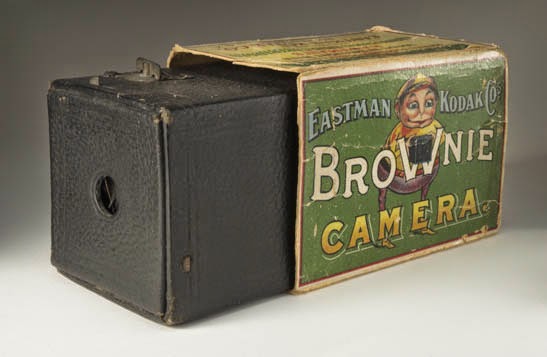
Apparently, that mindset remained until the Kodak Brownie became popular.  The very first Brownie was manufactured in 1901. A popular story Explaining how Kodak got its name claims that it was named for the sound the Brownie made when the shutter was pushed. (Frankly it sounded more like "KaPlunk" to me, but no company named KaPlunk would have been the same.)  

But that story is not true. George Eastman, the founder himself said that he'd simply made it up.
"I always liked the letter "K." It seems a strong and incisive kind of letter. It became a question of trying a great number of combinations of letters starting and ending with the letter "K" and "Kodak" is the result."

The "Brownie" was named after cartoon characters drawn by Canadian Cartoonist Palmer Cox which featured little fairy like figures called "Brownies."  (Notice original Brownie Box above.)


Anyway, Kodak began advertising it's camera, which sold for $1 dollar, by showing happy

people taking pictures of other happy people smiling and having fun.  Gradually, the message got out that it was OK to smile in photographs. Besides, these were a different kind of photographs. They were informal photographs of ordinary people.They were "snapshots." 

By the mid-20th century, photography in general had become much faster, much cheaper, and much more casual. People were also taking better care of their teeth. Smiling became, not only accepted, but almost mandatory when posing before the now ubiquitous ( I love that word) Brownie. "Say Cheese" were the magic words that 97.5% of the time preceded the "KaPlunk" of millions of Brownies.

-Lee