Sunday, June 22, 2014

Who Was That Masked Man?

It was me.

I'm going to tell you about it, even though my better judgment says not to.

In fact, the subject is listed as one of the top Ten subjects that make the official "Things No One Ever Said" list each year.

Such as,

"I love being tired."

"Happy New Year! I’m going to try to put on some weight this year. Particularly in my mid-section."


"I love the smell of wet dog."


I couldn’t tell at all - that is a really natural looking toupee."


and ,

Tell me again about your hernia operation.

In my case, the operation I'm writing about had nothing to do with a hernia, the one I'm speaking of was on my nose.  I seldom  mentioned my "nose job" to people because those I did tell about it couldn't resist suggesting I demand my money back.

However, it wasn't done for cosmetic purposes. 

When I was three years old, I slipped on the icy steps of Mercy Hospital after visiting my Dad, and crushed the bridge of my nose.  As I grew, the crushed bones did as well, obstructing more and more of my nasal breathing passages.


It reached critical mass, I suppose, about 1956 and I sought help from one of the Doctors at the University of North Carolina, where I was attending school at the time. Dr. Newton D. Fischer was his name, and I got the feeling that he had recently lost patience with students coming to him wanting "cosmetic nose jobs," which he didn't do.

"So, you don't like the looks of your God given nose, eh," he said.  And he went on from there telling me how vain and foolish I was, etc.....

When he finished, I simply said. "Yes. I wish my nose was better looking, but that's not why I'm here. I'm having difficulty breathing."

After examining me, he couldn't have been more apologetic. As it turned out, he arranged for me to have a combination nasal passage correction and bridge re-construction by the leading such surgeon in the country.  Dr. Maurice Cottle was his name and he had been Dr. Fischer's teacher in medical school.

The operation normally would have cost thousands of dollars, but Dr. Fischer arranged for me to have it done for "whatever my parents could afford."

Which was $300.


I flew to Chicago for the proceedure and returned to Chapel Hill afterward where Dr. Fischer took care of my post surgery needs which consisted mainly of changing the "mask" on my face which had to remain in place for a month.

The reason was to hold my new "bridge" long enough  for it to "attach" itself to my facial bones. Dr. Cottle had carved it from a bone he had shaved from my hip. Wearing a mask for that many weeks wasn't fun, but being able to breathe through my nose was well worth it.

I frightened the daylights out of a number of Chapel Hill and Charlotte merchants during those 30 days of my one man Halloween show.
There was a dry cleaner on Pecan Avenue who had his back to me when I walked in the store and almost ran out the back door when he turned and saw me and my mask. (Actually he told me there was no back door...but said he almost made one.)

The mask itself was simply medical tape that covered my face from the hairline to the tip of my "new" nose.

Dr. Fisher has passed on now but rarely have many days gone by since 1956 when I didn't think of how kind and generous that man was to me and how fortunate I was to have walked into his office that day.

As most of you know, I missed our 60th reunion because of a conflict with some surgery that came up. In conversation with the Doctor (Alain Drooz) beforehand, I detected a Southern accent and learned that he had done his medical studies at UNC.  Of course, he's much younger than me...Hell so is the Pope...but I asked him what the town was like now, etc. 
And, not expecting a positive reply, I couldn't resist asking if he had ever known a Dr. Fischer when he was at UNC.

"Dr. Newton Fischer?" he replied. "He was my faculty advisor."

I knew then my upcoming surgery was going to be successful.

-Ed


Thursday, June 19, 2014

Roll Call

John Brock
I'm proud to say that three of my very favorite writers are (or were) friends of mine:
Charles Kuralt, Jan Karon, and John Brock.

John is not as famous nationally as Charles and Jan, but his book Southern Breezes Whistle Dixie flat hit the spot with this 79 year old son of Charlotte, North Carolina.

John was in the Class of '51 at Central and was the son of the owner of Brock's Barber shop, on Caswell Ave behind Stanleys Drug store. Mr. Brock gave me my first haircut and just about every one after that until I moved to Washington.

John was kind enough to pass along a lot of the old photographs of Charlotte that I used a number of years ago in the slide show that I did for our class 5 years ago.  He was one of the original producers of the great slide show for his class, which frankly was the inspiration for the one I did for our class.

He also graciously allowed me to publish several of his stories on this website.

It was with great sadness that I received this email today:


You haven’t heard much from me lately but life can change directions in a big hurry and I need to explain a couple things. I recently started having some physical problems. Just as Barbara was getting over the worst of her health problems, I suddenly developed stage 4 cancers necessitating some significant life changes. I went into the hospital a week ago and yesterday transferred to a skilled nursing facility in Pawleys Island. Barbara will move tomorrow into an adjoining assisted living facility. Unfortunately, they say I only have a few months to get things in order.
Our sons and daughters-in-law have jumped right in to help with everything. Neighbors, friends, kin folk, church members and staff and others have joined in to help make things possible. I’m sorry I haven’t been able to convey this news personally so I’ve asked our son John, Jr. to contact you folks with this explanation of what’s going on.
We will try to keep you informed. For a while we’ll keep the same phone number and address. My love to each and every one of you.   

-John Brock Jr for my Dad


For years he wrote a weekly column for several Southern newspapers. This is one he wrote in May of 2007:

When the roll is called up yonder: my Mom will be there!

All indications are my Mother, age 92, is experiencing her final days on this earth. By the time you read this, she may be gone.
We knew the day was not too far distant three years ago when she moved to a nearby nursing facility. But, I was just thankful that for the first time in many, many years we were once again in the same town. Sadly, this seems to be coming to an end. But only God knows. She is a resilient woman and has survived cancer, a mastectomy and a broken hip in the last five years.

There’s nothing I can do. The professionals are doing everything they can to give her loving care and to make her as comfortable as possible. All I can do now is just go by daily and hold her hand. The time comes to us all, if we live long enough, when there is little left in this life. But in my Mother’s case, it’s not the end. There is a more joyous life at the end of this earthly tunnel. She has always believed this — and so do I.

In the meantime, I am unable to converse with her beyond a gentle greeting on my part and a slight recognition or an occasional smile from her. Her words are all used up, but, I can, upon occasion, garner a slight sense of recognition. Two-way conversation is a thing of the past.
Today, I found another means of communication. The door to her room was closed and I impulsively broke into song. Not just any song but her favorite old-time hymns.
Those who have ever sat beside me in church know full well that I cannot sing. I often feel the need to apologize to those around me when I try. But, today, I just felt it was the proper thing to do.
I was not wrong.

For a half-hour, as I fumbled through almost every hymn I knew by heart, her spirits rose and for a short while we were communicating. A broad smile crept across her face during the first notes of “Lilly of the Valley,” and broke even wider as we segued into other hymns from her childhood and mine. Her hand, help closely in mine, grasped tighter each time I came to one of her most favorites. The old hymns were speaking to her subconscious soul.

By the time the medical personnel came in, I thought Mom was about to join with me. A false hope, I’m sure, but nevertheless, it was a glorious time for us both. Now that I have found this method of communion, I will hold her hand and sing every day just as long as life prevails. Although her voice was not added to my meager offering of song, her soul sang right along beside me. It was marvelous.
As I sang, my mind wandered into the distant past as I recalled my Mom singing these same hymns to my youthful soul. Our roles, as often happens if we live long enough, have reversed.

Mother was always able to conjure a smile even in the face of despair. And prayer was the answer to all the trials of life. She came by it honestly. Her father was a deeply religious man and Baptist to the core. Although seminary trained before his health prevented further study, he was never a preacher but he “preached” daily by his example to his family and those around him. I was one who benefited from living near him early in my life. Mom has sustained his spiritual devotion through the years. Hopefully, I enjoy some benefit as well.

Another thought came to me today as I witnessed the joy in Mom’s eyes. I was reminded that every time I go into a church today, I see a sea of gray heads – other older folks harvesting the last years of life. I understand that churches want to seek younger members into the fold, but in the process, we should not miss the opportunity to speak to the souls of older members. In my view, no church service is complete without the inclusion of at least one or two of the old hymns: Old Rugged Cross, Amazing Grace, What a Friend, Living for Jesus, Rock of Ages, Bringing in the Sheaves and others of that genre. An occasional old-time gospel song wouldn’t hurt either.

The sermon tops off a perfect service where aged and youthful souls are both nourished.
I don’t fully fathom the spiritual side of death and dying but I do know one thing for certain:
“When the Roll is Called up Yonder,” — Mom, you’ll be there!
Hallelujah!

John Brock lives in Georgetown County and is a retired college professor/administrator and newspaper editor/publisher. He can be reached by mail at this newspaper or via Email: brock@johnbrock.com. His website is: www.SouthernObserver.com.


Friday, June 13, 2014

Red Ryder and his Peace Maker

House Sparrow
In the early 1890's a homesick Englishman named Nicholas Pike brought 50 House Sparrows from England and released them in Brooklyn, New York.

Today, the house sparrow is the most common bird in America and one of the meanest, aggressive and most obnoxious in the world. They have driven our native birds like the lovable, peace loving Bluebirds and Purple Martins out of house and home. The house Sparrows are ferocious fighters and will evict ANY nesting bird from a cavity and take over the site. They tear up nests, break eggs, kill and toss out nestlings and adults and then build their nest right on top of the carnage.

They are the terrorists of the bird kingdom.

The Gentle Blue Bird
I get mad just reading about those damn birds, so you  can imagine how upset our classmate, the
Reverend Don Nance felt sitting on his porch in the mountains of Virginia watching Osama Bin Sparrow and his henchmen constantly attacking the Bluebird family that had taken up residence in his backyard.

It would have been upsetting enough to make any preacher cuss, and knowing Don like I do, I'm sure he dropped at least a couple of "Dag Nabbits" that caused the chinaware to shake.

And then he acted.

He went right down to the local Walmart and purchased a...

Well, his first choice of weapons was a Cannon, but he had cooled down by the time he got to the store and bought a Red Ryder BB gun instead.

After all, he had no intention of killing the sparrows....just scaring them away from the Bluebird's nest until the Blue Bird eggs had a chance to hatch and the baby birds survive.

Ralphie from Xmas Story
Meanwhile, Letty went into her wifely/Motherly default mode and expressed her opinion that buying a BB gun was probably not a good idea. "You could put out your eye with that thing, and......and...who knows what."

Those last three words were downright prophetic.

I like stories with happy endings....and this one ended happily... for the Bluebirds. Don, and Red Ryder, kept the evil sparrows at bay while Junior and his feathered sister graduated from the nest and lived happily ever after.


And peace and tranquility returned to the sleepy community of Wytheville, Virginia.

Until that loud knock at the Nance door.

"Open up, it's the Police."

Well, they really didn't say that, but anytime you see the Police standing at your door, they might as well have announced themselves like that.  They actually said, "Reverend Nance, we are sorry to bother you but there has been some vandalism in this neighborhood lately and we wondered if you have seen any teenagers wandering around with BB guns. Your next door neighbor, had his expensive picture window shot out the other day with a BB gun.

Don realized immediately that the "jig was up" and admitted his guilt even though it was hard to believe that an errant BB shot of his would travel a distance of 300 yards, and blow out a picture window of his neighbors house. The pellet was still in the home and sure enough it was silver, just like the ones he was using.

Don paid for all the damage and the case was closed.

Nevertheless, I sure wouldn't have wanted to be in Don's shoes and have to explain to the Police that.....

"You see, officer, in 1890, a homesick Englishman named Nicholas Pike brought 50 House Sparrows to Brooklyn New York from England...."

-Ed


Saturday, May 31, 2014

Bureaucracy 101

If a picture is worth a thousand words, and I believe it often is, then this one needs to be shown to all of your liberal friends and relatives to help them understand why Obama Care will be just as screwed up as the Veterans Hospitals and medical care are.


It's from a January 2014 article in Townhall.com by Daniel J. Mitchell called "Are Government Bureaucrats Corrupt and Dishonest?

Important Announcement from the California Bureaucracy!

Sacramento (May 7) — This financial crisis is forcing California State and local agencies to make some tough decisions. If things continue for much longer, there’s a real risk that we may have to lay off Jose.

Friday, May 30, 2014

I Keep Forgetting I Forgot About You

Country Songs have a way of getting right to the point.

What more powerful  way of expressing a broken heart than saying, "You Done Tore Out My Heart and Stomped That Sucker Flat.

How could you tell someone goodbye more succinctly than, "If your phone don't ring, it's me."
or, "I Don't Know Whether To Kill Myself or Go Bowling."


or.........


 I'm So Miserable Without You; It's Like Having You Here.

 My Wife Ran Off With My Best Friend and I Sure Do Miss Him.

 You're the Reason Our Kids Are So Ugly.

 How Can I Miss You If You Won't Go Away.

 I Liked You Better Before I Knew You So Well.

 My Head Hurts, My Feet Stink, And I Don't Love You.
.
Her Teeth Were Stained, But Her Heart Was Pure.

Drop Kick Me, Jesus, Through The Goalposts Of Life

 I'd Rather Have A Bottle In Front Of Me Than A Frontal Lobotomy

I'm Just A Bug On The Windshield Of Life

 If You Don't Leave Me Alone, I'll Go And Find Someone Else Who Will

 If You Leave Me, Can I Come Too?

Thank God And Greyhound She's Gone

 You Were Only A Splinter As I Slid Down The Bannister Of Life

The Next Time You Throw That Fryin' Pan, My Face Ain't Gonna Be There

Sorry about that. I got carried away.

What I wanted to write about is the "bad rap" that people our age are often accused of .........being senile...a slightly nicer way of saying "demented."

I found some comforting information on the internet under the title HelpGuide.com:

"The brain is capable of producing new brain cells at any age, so significant memory loss is not an inevitable result of aging. But just as it is with muscle strength, you have to use it or lose it. Your lifestyle, health habits, and daily activities have a huge impact on the health of your brain. Whatever your age, there are many ways you can improve your cognitive skills, prevent memory loss, and protect your grey matter.
Furthermore, many mental abilities are largely unaffected by normal aging, such as:
  • Your ability to do the things you’ve always done and continue to do often
  • The wisdom and knowledge you’ve acquired from life experience
  • Your innate common sense
  • Your ability to form reasonable arguments and judgments

Normal forgetfulness vs. dementia

For most people, occasional lapses in memory are a normal part of the aging process, not a warning sign of serious mental deterioration or the onset of dementia.

Normal age-related forgetfulness

The following types of memory lapses are normal among older adults and generally are not considered warning signs of dementia:
  • Forgetting where you left things you use regularly, such as glasses or keys.
  • Forgetting names of acquaintances or blocking one memory with a similar one, such as calling a grandson by your son’s name.
  • Occasionally forgetting an appointment.
  • Having trouble remembering what you’ve just read, or the details of a conversation.
  • Walking into a room and forgetting why you entered.
  • Becoming easily distracted.
  • Not quite being able to retrieve information you have “on the tip of your tongue.”

Does your memory loss affect your ability to function?

The primary difference between age-related memory loss and dementia is that the former isn’t disabling. The memory lapses have little impact on your daily performance and ability to do what you want to do.
When memory loss becomes so pervasive and severe that it disrupts your work, hobbies, social activities, and family relationships, you may be experiencing the warning signs of Alzheimer’s disease, or another disorder that causes dementia, or a condition that mimics dementia."

For the Complete article go to: http://www.helpguide.org/life/prevent_memory_loss.htm


David Alan Coe
...and finally, here is David Alan Coe singing the "Perfect Country and Western
Song."

Be sure to stay with it til the end.....

http://www.youtube.com/watch?v=jkKn5HrKgHQ


-Ed


Monday, May 26, 2014

We've Come a Long Way...Baby

Yep.


What would happen today if the President of the United States handed this out to all of our members of the military?

The stories our veterans of WW2 told abouit those Bibles are legion. "There are no atheists in foxholes" is not much more than a cliche these days, but to those who fought for our survival and freedom, the foxholes were real. To have some comfort in you pocket was not a small thing.

 In some cases it saved their physical lives. Worried parents even sent extra protection in the form of metal covers for the bibles.


The government Bibles were one of the two most popular items carried into combat by our WW2 heroes.  The other was


the Zippo cigarette lighter.


Oh, and what would happen if an American President did this today?


He would probably be impeached.

-Ed


Sunday, May 25, 2014

Growing Up Under a (Mushroom) Cloud

1950's School room defense tactics
 I don't believe there was a better time nor place to grow up when we did than in America; and yes, Charlotte, North Carolina.

It would have been almost perfect, if it hadn't been for that black cloud...that was always in the back of our minds; the  thought that we could all be nuked at any moment.

World War Three was never totally out of our thoughts because from 1947 until the 1990's there was always the real possibility that sooner or later it would begin.

Waiting
Our leaders and our Military war planners had a code word for it. It was a word very few of us had ever heard and indeed still have no idea what or where it is.

The word was FULDA.

Fulda is a small town in West Germany and just on the outskirts is the Fulda Gap, which was  the most heavily armed place on earth. More than a million U.S.and Soviet soldiers were lined up not 400 yards apart.That's where intelligence sources said World War Three would most likely start.

U2 Pilot Powers
It almost did on May 1, 1960 when Francis Gary Power's U2 spy plane was shot out of the sky over Soviet Russia.


 "Don't you fly into the Soviet Union! Don't you fly into the socialist countries!" Khrushchev demanded. "Respect sovereignty and know your limits! If you don't know your limits, we will strike!" 

American defenses went on alert.
Fulda Tunnel


An Army special weapons officer from the 23rd Engineer Battalion  (Armored Division) and his platoon were immediately sent to the nearby Fulda tunnel.....which separated the opposing armies...with a fully armed Atomic Bomb and the "Target Folder," taken from the super secure"safe,"which contained the activation codes needed for detonation and  orders to destroy the tunnel.


Had cooler heads not prevailed, A 1954 graduate of
Central High School would have set off America's first Atomic
bomb of World War Three.

His name: Obie Oakley.
 
Fascinating stuff, indeed!

Whew!


Obie in Fulda


 Obie writes about this and much more in his latest book, MAKING OF A SOLDIER, which is both a personal journey and a close up look at the men of our military in potentially the most dangerous place and era of our lifetime.

Those who know Obie best often describe him as a "born" soldier.

But as far as I could discover, that aspect of his personality didn't begin until 1941, when he was 5 years old...and continues to this day.
Obie in 1941 

He wrote the book as a fund raising effort for the Freedom Foundation which honors veterans.


If you would like to view a free online version, contact him at obieoakley@frontier.com for that link.

A printed copy is available for a $50 donation.  Go to www.carolinasfreedomfoundation.org.  Click Donate


Editor's note: As far as experts can determine, this was the only such deployment in U.S. Military history. Obie's commander at Fulda was  Colonel
Harry Mumma who has been quoted in recent years regarding  Obie's Atomic bomb deployment:

"As an afterthought, it is hard to imagine that a 23
year old 1LT and his platoon were being entrusted with the responsibility of setting off a nuclear device!"

Obie Oakley


Reminder: Twenty years ago, Obie and two friends
raised the money to build the Vietnam War
Veterans Memorial in uptown’s Thompson
Park. He’s chaired boards and he’s been a
prime force behind the Carolinas Freedom
Foundation, which puts on the yearly
Veterans Day parade  

-Ed 


Sunday, May 18, 2014

Little Things Mean a Lot

 (This is a story I wrote for my high school class of 1954...which just held their 60th reunion...)


"Blow me a kiss from across the room...Touch my hair as you pass my chair, little things mean a lot." -Kitty Kallen

That was one of OUR songs back in 1954 and I've been humming it all day thinking of all you lucky Wildcats who attended our 60th Reunion last week.

I'll bet the farm that 99.9% of the conversations that night were about those "Little Things"...that memories of are made of.

I know mine are:
Bo Madden

Second Grade teacher was asking us to stand and say our names:

MISS TERRY:  "And what is YOUR name young man?"
BO MADDEN:  "BO"
MISS TERRY:  "Well, you must have a last name; besides BO is just a nickname...for, oh, probably Boregaurde. So, again, what is your name?"

Pause...

(firmly)  "BO!  BEE OH, BO!"

From then on, he was always "B.O. BO" to me.

The Elizabeth School janitor and all around fix it guy was a very large man named Mr. Williams. I never saw him without a huge wad of tobacco in his jaw.

But I never saw him spit.  Amazing.'

My favorite bus driver (6 ELIZABETH) was Mr McKeever.

My greatest ambition at Elizabeth School was to someday be a patrol boy. You were chosen by your 5th grade teacher, who, in my case was Miss Willis. I forget what month it was, but I know what DATE it was.  It was the 8th of something.  That was the day I had convinced my Mom that I was too sick to go to school.  But, amazingly, later that day, I felt good enough to go out and play with my friends who, poor souls, had spent the day in school.

As luck would have it, who would come driving down East 5th Street, just as I was catching a long pass ..on the vacant lot next to the street but Miss Willis.

That night, I marked every 8th day of every month on the family calendar....BAD DAY! I could see my Patrol Boy Career going down the drain.

Miss Willis was driving one of those new fangled Kaiser/Fraser automobiles.  Wearing a Blue dress.

Some things you never forget.

She had a bit of a mean streak, although she DID recommend me for Patrol Boy; I've never forgiven her for punishing a boy named Charlie Stone who acted up a little in class one day....and she refused to allow him to participate later that day in our orchestra concert that he had worked so hard on all year.

Seeing him cry at his desk that day still haunts me.

I loved comic books, in fact, that's how I learned to read. My first attempt at being creative was to draw a primitive comic story of my own one day and got up enough nerve to show it to one of my 4th grade classmates, Richard Stowe.  To my amazement he said he liked it!

That's all the encouragement I needed! I've never stopped telling stories.

Things I learned from other's mistakes in class:

South Carolina is NOT the Pimento State.

If you are ever tempted to forge your Mom's signature on your report card, DON'T spell her first name, MISS.

Clorox 1940's bottle
And don't believe everything your friends tell you.

For example, "CLOROX  will erase INK"

Changing a D to a C burned a damm hole right through my report card.

-Ed


Friday, May 16, 2014

Mama's Bible

I went into a home one day just to see some friends of mine
Of all their books and magazines, not a Bible could I find
I asked them for the Bible when they brought it, what a shame
For the dust was covered o'er it, not a fingerprint was plain

                          Dust on the Bible    - Popular Country Western song 1959

Her name was Nora Kate Cartee but my sister and I knew her as "Mama," because that's what our Mother called her.

The Cartee home in Anderson, SC
 Kate was 16 years old when she married John Andrew Jolly on March 30, 1904. He died July 30, 1910, leaving her and their four small children penniless.  They moved into her childhood home with her widower father in Anderson, South Carolina where she single handedly raised the two girls and two boys. Their small farm and garden supplied their food, and "Mama" made all their clothes on a Singer sewing machine....operated by "foot power."


The children all grew up to become fine citizens with families
Singer machine 1910
of their own. My Mom didn't dwell on her childhood poverty but brought it up a few times, usually around Christmas to let my sister and me know how fortunate we were and how grateful we should be for all the presents we had under our tree compared to her typical gift each December 25th of...one orange.


The reason I know the exact dates of those events of over 100 years ago is that Mama's "Family Bible," which I so carefully brought up to Virginia and stored away when we cleaned out my Mother's home in Charlotte, had a few pages in the middle designed for the owner's Family Records.

A hundred years of Births, Marriages, and deaths are all there...but as I was looking through that old tattered book for perhaps an underlined verse or two or maybe a personal notation in the margin...I could find nothing that might give me some insight as to how she and millions of other Americans coped in those harsh days before modern medicine and miracle drugs.

The family records were the only handwritten notes there.. I found no hint of a message or clue that might suggest the secret of her strength.

Only an orange at Christmas for the kids makes me sad enough, but just imagine what parents like Mama went through when their children got sick.  It was worrisome enough for us, even though we knew the antibiotics would almost certainly pull them through if necessary. Something as simple as strep throat, which was called scarlet fever back then, was a major cause of death.

In 1900, nearly 165 of every 1,000 children born in America died before their first birthday (in some cities this number was as high as 300). If they survived infancy, children still had to fight to survive: at the turn of the century, 20 percent of the nation's children died before the age of ten.   -Wikipedia

It a shame the book is in such terrible shape. It was like that when my Mom brought it up from South Carolina after Mama died.

As I contemplated the effort it would take to have the book rebound into "presentable shape," it
Mama's Bible
suddenly occurred to me that Mama's "secret" had been staring me in the face all along.

It was that tattered book itself!  

There were no magic pills for her sick children during those long dark nights....but there was one thing she could reach for...

and she literally wore it out.

-Ed  


(It also dawned on me that I may have inspired a new Country and Western hit song...if it doesn't already exist   -Ed)

Saturday, May 3, 2014

Norweigian Wood

Speaking of violins,  when I was 9 years old a teacher, who was trying to get youngsters interested in taking music in school visited my 4th grade class and played a couple of bars of the William Tell Overture (the Lone Ranger's theme song). That's all it took.
I fell in love! 
Judy Anderson and Ed


I went on to study the violin for 10

years. I would still be playing, except for the fact that the violin is jealous lover. She demands strict loyalty and faithfulness. (Two or three hours of practice a day minimum..to play well.)

For me there were too many flashy distractions; broadcasting being the one I finally settled down with.

About the 7th or 8th grade, my teacher, Mr. Michael Wise advised my parents that I had progressed as far as I could go on my "learning violin" and offered his advice if they decided to make the investment. 

Only the strings (and bridge) missing
 It took a while, but he called my Dad a few months later and said that a woman had called him about a violin she had found in the attic of a deceased relative...which she wanted to sell.


"She's asking a lot of money for it," he said, "but I've examined it and it's worth it."

She was asking $300 for it.

My folks bought it for me.

It was certainly a good sounding instrument as well as a very beautiful work of art.
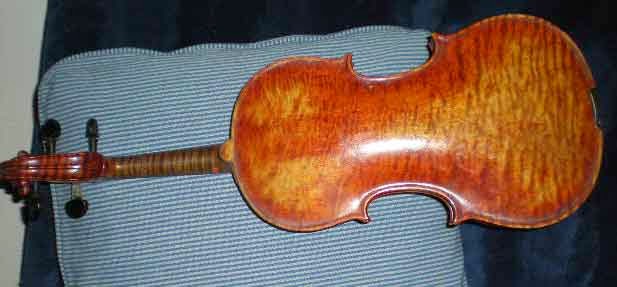
Peering inside (through one of the "F" holes) the label said it's maker was:

 Knute Reindahl  Chicago  February 22, 1911

 I never knew anything more about it. 

But Knute's baby and I were almost inseparable in the 50's, attending Piedmont, then Central together. Waiting at bus stops for the 6 Elizabeth to come along...often walking home,sometimes in the rain...always carrying "old Knute." 

Ed's Knute Reindahl violin still in perfect shape

It's a wonder that delicate old instrument survived.

It's a wonder I survived.

A Little boy carrying a violin case to school was to other little boys, like waving a red cape in front of a bull...there was something about it that seemed to send a "hit him" or at least call him a "sissy" message to the young male's mind.

That's how Don Nance and I became such good friends. Don weighed close to 200 lbs in the 5th grade and very early on in my musical pursuit, the other boys realized that if they bothered me, they would have to deal with Don. We've been best friends ever since.

At any rate, as I go through the Bat Cave and mark DO NOT LET THE WE HAUL JUNK TRUCK TAKE THIS... label on some of my treasures I decided to see if there was any information on the internet about Old Knute,the man who made my violin way back in 1911.

The first thing that jumped out at me was an ancient Chicago newspaper clipping:

 The well-known Norwegian-American violin maker, Knute Rheindal, is back from a visit to Norway. Mr. Rheindal is known as Chicago's Norwegian Stradivarius, due to the wonderful tonal quality of his handmade violins. The purpose of his trip to Norway was not only to visit the home of his childhood,but to obtain materials for violin making. Doorposts, thresholds, planks; all hundreds of years old stripped from age old buildings and shipped here. 

Oh my!
 
Stay tuned for PART TWO.....

-Ed

Friday, May 2, 2014

Norweigian Wood (Part TWO)

  "The well-known Norwegian-American violin maker, Knute Rheindal, is back from a visit to Norway. Mr. Rheindal is known as Chicago's Norwegian Stradivarius, due to the wonderful tonal quality of his handmade violins. The purpose of his trip to Norway was not only to visit the home of his childhood,but to obtain materials for violin making. Doorposts, thresholds, planks; all hundreds of years old stripped from age old buildings and shipped here."

Luthier's (string instrument maker's) label inside Ed's violin

That short blurb in an ancient Chicago newspaper was the first thing I ever learned about the man whose name was pasted on the inside of the violin I carried daily through Junior and Senior High School. Until now, thanks to the Internet, I never knew anything at all about  Knute Reindahl.

I don't believe my schoolmates would have recognized me without my violin case. Inside that case was a $300 instrument Mr. Michael Wise found for me in 1948. Back then I had childhood dreams of becoming a world renowned concert violinist basking in the glow of wild audience applause and adoration (especially from women). However, reality struck about the time I entered Central High and discovered there were other kids as good, or better than I was.

So much for that concert violinist surrounded by adoring women fantasy.  I was going to have to go to plan B. Whatever that might be.

But I still enjoyed practicing and playing the fiddle, and didn't put it away for good until my senior year in college.

I packed it up around 1957, still knowing nothing about the history of that beautiful handmade work of art that had been my constant companion all those years.

Fast forward to the present. Since none of my children, nor grandchildren, exhibited any interest in learning a musical instrument I decided to give it away to some deserving student. But until then, I would see if there was anything on the Internet about the man who had carved the work of art that had been my close companion for all those years.

Knute Reindahl
I discovered that Knute Reindahl was born in Norway. He lost his father when  was only 3 years old. His widowed mother emigrated to America with her 7 children when Knute was 9 . They settled near Madison Wisconsin where Knute developed a friendship with the Indians in the Monona area. He later wrote of this experience,  

"In summertime I loved to visit the Indian camps. I even tasted the smoked muskrat and skunk meats which hung in the peak of their tents. And while I was showing the Indians what I could do with my knife, they gave me lessons in bow and arrow making. It was not long before I was peddling in the stores...one bow and two arrows for 25 cents."

He moved to Chicago and began making violins seriously in 1899 (he had made his first violin when he was 13 years old) and had a very successful shop in for 25 years.

In 1900 Reindahl exhibited his violins at the World's Fair in Paris and won a gold medal for their beauty of tone and artistic workmanship.  The Chicago Symphony moved into the spacious Orchestra Hall on Michigan Avenue in1905 and the director ordered 5 Reindahl violins to replace older European instruments which lacked sufficient power to be adequately heard in the new, larger hall.

Reindahl's 5 daughters outside their home near Madison
In 1911 Knute moved his family back to the area where he had spent much of his youth, near Madison Wisconsin. The area where his home was located is now an official landmark in the town of Monona.  

In 1922 the town of Madison presented  the world's famous violinist, Fritz Kreisler with one of Knute's violins on the occasion of Kreisler's becoming an American citizen. 

Later, Knute's  peers voted unanimously to elect him the first president of the newly formed American Academy of Violin Makers.

Knute died January 17th, 1936. 

According to the Internet,the going price for a Reindahl violin is now anywhere between 5 and 10 thousand dollars. 

Am I going to give it away, or sell it?

Nope. It's going back in the attic to wait for the right musically talented Shephard/Myers great (great?) grand kid to come along.

 I'm also going to include a note in the case advising him to make friends with the biggest kid in the school.   

Thanks for the memories, Knute.  Rest in Peace.

-Ed

($300 in 1948 had the same buying power that $2,941.41 has today)